
What would it mean for schools to become places of healing rather than merely achievement?
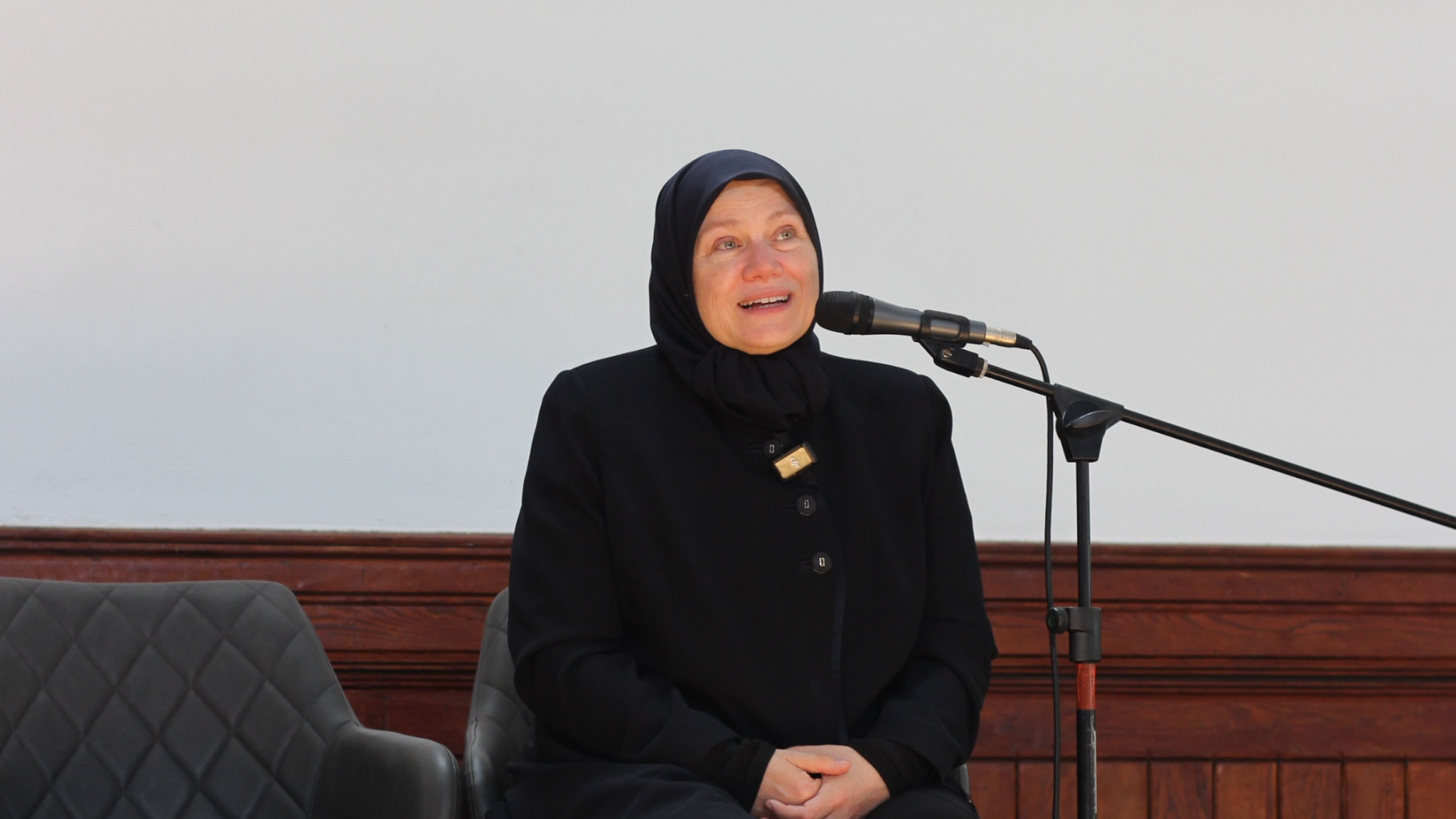
That was the question at the Islamic Schools League of America’s (ISLA) 2026 Virtual Ramadan Fundraiser, Shaping the Future of Islamic Schools: The Ripple Effect That Starts With You. Among the featured panelists was Ribāṭ University’s president, Dr. Tamara Gray.
Dr. Tamara is also the founder and CEO of Rabata, an organization dedicated to positive cultural change through creative educational experiences, with a focus on uplifting Muslim women and engaging faith communities in digital spaces. She is also a senior fellow at the Yaqeen Institute for Islamic Research and board chair of the Minnesota Multifaith Network. For anyone considering a career in education, or already in the classroom wondering whether the profession can still hold their ideals, her remarks offered both a diagnosis of the field and a hopeful vision for its renewal.
Undoing a Split We Never Agreed To
Asked how Islamic schools might contribute to healing a field marked by teacher attrition, student anxiety, and a widespread loss of purpose, Dr. Tamara invited listeners to reconsider one of modern education’s deepest assumptions.
“We weren’t in the room when the world decided to separate secular and sacred,” she said.
For Muslims, integrating knowledge is not an educational innovation but a return to a more natural way of seeing the world, one in which the sacred is inseparable from every other form of knowledge. As she described it, this is “an approach to the world where that which is sacred, or that which is spiritual, is part and parcel of that approach.”
To illustrate the limitations of prevailing educational models, she pointed to Howard Gardner’s work on multiple intelligences. Although Gardner explored whether spiritual intelligence should be recognized alongside his other intelligences, it ultimately did not become part of his framework. Dr. Tamara Gray suggested that this may reflect, as she put it, the long-standing separation of the sacred and the secular within modern education, making it difficult for a secular academic paradigm to fully account for the spiritual dimension of human development.
She believes the opportunity for Muslim educational institutions is already visible. When schools achieve academic excellence while also graduating students who are spiritually grounded, emotionally healthy, and deeply connected to their faith, they offer something the wider world is searching for. Such institutions, she said, “bring the sacred back to the world.”
“The world is definitely thirsty,” she observed. In Minnesota, she has seen non-Muslim community members turn to Muslim communities looking for precisely that sense of healing and wholeness.
Teachers Cannot Transmit What They Have Not Been Taught
When the conversation shifted to student well-being, Dr. Tamara deliberately redirected the focus toward the adults responsible for shaping students’ lives.
“Unless we are learning or thinking about how to teach teachers . . . it’s not really fair to expect that they’re going to be able to teach young people how to do it,” she said.
Schools often ask for tarbiya to be incorporated into the curriculum. But meaningful formation, she explained, must begin with educators themselves. Too often, teachers are expected to cultivate qualities in students that they themselves have never been given the opportunity or support to develop. She observed that resistance to this kind of work often comes not from unwillingness but from a lack of tools. When educators are unsure how to engage in their own formation, it can feel safer to remain with what is familiar than risk failure in unfamiliar territory.
One example is the scholarly personal narrative (SPN), a research methodology developed by educator Robert Nash that requires students to integrate academic scholarship with deep personal reflection. Rather than writing a conventional master’s thesis, Ribāṭ University graduate students will complete an SPN.
“The SPN forces you to understand the theoretical, but also to understand the self, and learn how to put them together.”
For Dr. Tamara Gray, the significance extends beyond a single research methodology. Nash created an entirely new form of academic inquiry, a reminder that educational methods themselves can evolve. Muslim scholars and educators, she suggested, need not simply adopt existing models. They can also develop new approaches that emerge from their own educational vision and respond to the needs of their communities, contributing fresh ideas to the broader field of education.
“We’re not stuck,” she said. “We also get to be creative and think about what we need to do to help our teachers become excellent at this work.”
Rethinking “Burnout”
Asked how the profession might recover its sense of dignity, purpose, and amāna at a time when many educators are leaving the field, Dr. Tamara Gray offered three priorities.
First, rethink administration with courage.
Teaching, she reminded the audience, is a profession. Too often, schools are led by people without formal training in education who introduce policies that burden teachers rather than support them.
“The administration is not there to give teachers to-do lists. The administration is there to reduce the load of teachers.”
Healthy schools, she suggested, should never carry more weight in administration than in the classroom. Their greatest investment should be in teachers and teaching rather than expanding administrative structures, because the primary role of administration is to make excellent teaching more possible, not more burdensome.
Second, nourish teachers rather than merely train them.
Teaching is inherently a profession of giving. Even educators who deeply love their work eventually empty their reserves if they are never replenished. She compared this to the fiqh principle that a person who possesses only enough water for their own wuḍūʾ cannot give it away to someone else. Professional development, therefore, should attend not only to instructional strategies but also to teachers’ own spiritual and personal formation.
“Not boring PDs that have a thousand minutes of icebreakers,” she added with characteristic humor.
Third, reconsider the language of burnout itself.
Rather than viewing teachers primarily as exhausted, she suggested that many are frustrated by institutional dysfunction.
“Burnout is also a Western concept,” she said. “We’re not actually burned out. We’re fed up . . . of ridiculous treatment, people not listening, not being able to do the work we want to do.”
Helping teachers establish healthy boundaries, focus on meaningful work, and recover a sense of agency, she explained, is essential to creating what she described as “a fully focused teaching life.”
Where This Is Headed: Pedagogy as a Sacred Discipline
The through line of Dr. Tamara’s remarks was unmistakable. The next generation of Islamic educators will need preparation that neither conventional teacher education programs nor occasional professional development workshops can provide. They need formation where educational theory, practical teaching, and Islamic epistemology develop together.
The vision she described closely reflects Ribāṭ University’s approach to preparing educators.
Launching in Fall 2026, Ribāṭ offers a Bachelor of Arts in Applied Pedagogy and Innovative Learning. During the panel, Dr. Tamara described it as preparation for “a future of education where things will change,” equipping Muslim educators to carry the torch of the Islamic tradition into contemporary classrooms.
Ribāṭ University also offers shorter credentials for working teachers and schools investing in their staff. These include an Associate’s and Certificate in Teaching Islam, an Associate’s in Teaching Arabic, and a Certificate in Arabic Language and Cultural Fluency.
In keeping with its commitment to reducing educational debt in the Muslim community, tuition is $5,000 per year, not per semester.
As a university created by women, for women, Ribāṭ University seeks to embody the very integration Dr. Tamara Gray described: a place where students are “soaked in Islamic epistemology, where the secular and the sacred are coming together.”
The field of education is searching for renewal. Dr. Tamara Gray’s message was clear: The Islamic tradition holds resources equal to this moment, and meaningful educational renewal begins with how we form teachers.
Learn more about the Applied Pedagogy and Innovative Learning program and Ribāṭ University’s full range of degrees and certificates at ribat.rabata.org.
Quotes are lightly edited from the live event transcript for clarity. The full recording is available through ISLA.