
By Ustadha Sahar A. Dandan, Ribaat Instructor
I remember sitting on the floor with my daughter, who was working on her latest project, a precariously balanced tower of blocks that had taken twenty-three attempts to build. She was counting. When it inevitably toppled, she stared at it, her lips trembling, but instead of a meltdown, she looked up with eyes glistening. “Mama,” she said, “number twenty-four.” In that moment, I saw her differently. She was not a child needing fixing, but a soul already embodying the patience and persistence I strive to cultivate in myself. Her frustration did not stop her. She did not see failure, and I saw her spirit.
Our children arrive in a state of fitra; they aren’t blank slates to be written upon, but mirrors reflecting back to us the very qualities we hope to instill. Al-Qadi Abu Bakr ibn al-Arabi wrote in Maraqi al-Zulfa: “Know that the child is a trust given to their parents. Their pure heart is like a precious, untainted gem, free from any engravings or impressions . . . If the child is accustomed to good and taught it, they will grow up upon it and achieve happiness in this world and the Hereafter. If neglected, they will be wretched and destroyed, and the sin will be upon those entrusted with their care.” The pivotal Maliki jurist, Ibn Abi Zayd al-Qayrawani, mentions in his introduction to Risala: “The best hearts are those most receptive to good, and the most hopeful hearts for good are those to which evil has not preceded.” Our children aren’t empty vessels that need to be filled, but surfaces that reflect the spiritual and emotional environment we create.
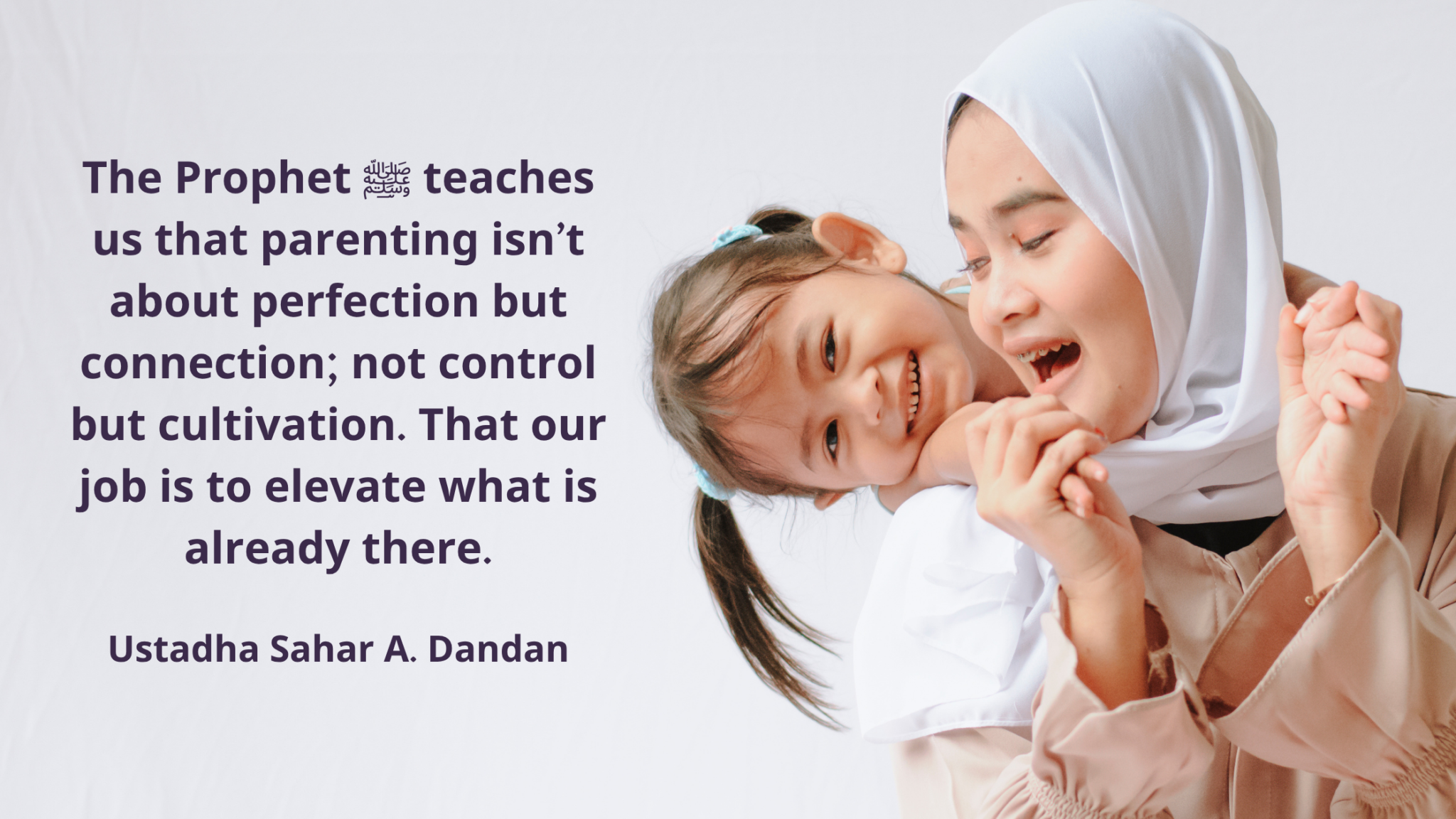
The Prophet Muhammad ﷺ didn’t parent children with checklists but with presence. He ﷺ crawled on the floor with his grandchildren, kissed them, listened to their stories, and lamented those who did not show mercy to children. He ﷺ teaches us that parenting isn’t about perfection but connection, not control but cultivation. That our job is to elevate what is already there. Consider Luqman (peace be upon him), whose entire parenting legacy in the Quran consists of eight verses of counsel. He didn’t command obedience but invited understanding: “My son, if even the weight of a mustard seed were hidden in a rock or anywhere in the heavens or earth, God would bring it [to light], for He is All Subtle, All Aware” (Quran 31:16). His wisdom wasn’t delivered through lectures but woven into everyday moments, a teaching model that honored his son’s capacity for reflection rather than demanding blind compliance.
When my daughter’s tower fell and she asked to try again, she wasn’t merely learning persistence, she was navigating a space between frustration and understanding. This is where growth happens. She knew the discomfort wouldn’t last, that that moment of uncertainty was part of the journey from unknowing to knowing, from falling to rising. In her very determined “number twenty-four,” she was reflecting the patience I’ve tried to embody when my own plans crumble and when I feel a loss of motivation as I struggle on my journey of learning.
When she gently comforts her stuffed animals after a nightmare, she is mirroring the compassion I’ve shown her. She’s demonstrating that she has internalized not just what to do, but how to move through discomfort with faith in the process. This threshold between what was and what will be is where transformation occurs, not through constant intervention, but through the environment I’ve nurtured that teaches her the rhythm of falling, learning, and rising again.
In our modern context, where screens compete for our children’s attention and societal pressures distort their sense of self, the Prophetic approach is revolutionary. We’ve been sold the myth that parenting requires constant correction, that our children’s behavior must be meticulously managed to prevent them from becoming “spoiled” or “undisciplined.” We become their manager rather than their parents. Perhaps the most transformative discipline is not in managing our child’s emotions but in regulating our own. What if the most powerful teaching happens not during “lessons” but in the everyday operations of a household, when we’re folding laundry together or walking to the park, with our hearts and minds open to the lessons of life?
Have we asked ourselves why we have embraced all these ideas that are not from our tradition? Why do we call them the “terrible twos” when we can see it as our children beginning to assert their God-given autonomy? That maybe instead of us suppressing this spark of selfhood, we guide it toward righteous expression. When my daughter insists on picking her own clothes or pouring her own milk, or destroying a puzzle that I helped her with, or tearing apart a page of coloring that I insisted she color between the lines, I’m not merely tolerating defiance, I’m honoring Allah’s design within her, coming to an acceptance of who she is, and deciding not to project how I think things should be.
This perspective liberates us from the tyranny of perfectionism. Parenting isn’t about eliminating mistakes but modeling islah. When I lose my temper and speak harshly, I don’t pretend it didn’t happen. Instead, I acknowledge my behavior and its inappropriateness, and I ask for forgiveness. This isn’t weakness; it’s the essence of Prophetic parenting. The Prophet ﷺ corrected his companions (may Allah be pleased with them) with mercy, saying, “I was sent to perfect good character,” not to enforce flawless behavior.
The most radical act of faith-centered parenting might be creating space for play: real, unstructured, imaginative play where children aren’t constantly directed or evaluated. The Prophet ﷺ raced with Aʾisha (may Allah be pleased with her) and played with his grandchildren. He understood that joy isn’t frivolous but foundational. When my children build forts from blankets and cushions or transform cardboard boxes into forests and classrooms, they’re not just passing time, they’re developing the creativity and problem-solving skills that will serve them throughout life.
As Muslim mothers navigating complex modern realities, we must consciously break intergenerational patterns that contradict Prophetic ethics. If we were raised with harsh discipline, we can choose gentle correction. If we absorbed messages that equated worth with achievement, we can teach our children that their value is inherent, not earned. This isn’t about rejecting our parents’ wisdom but refining it through the lens of our tradition.
Parenting in Islam is ultimately an act of tawakkul. We are trusting that Allah ﷻ has entrusted us with these souls not because we’re perfect, but because He knows we can grow alongside them and each time we choose patience over anger, love over fear, connection over correction, and mercy over judgment, we’re not just raising children; we’re polishing mirrors that reflect divine light back into the world.
So I ask you: What reflection are you creating in the mirrors entrusted to your care? How could your next interaction with your child shift if you saw not a problem to fix, but a mirror showing you all the rust that needs polishing in your own heart?
And here’s a reflection for the road: Perhaps Allah does not ask us to be perfect parents, only hearts that keep returning to Him with sincerity, even in their imperfection.
Ustadha Sahar A. Dandan will be teaching Sacred Bonds: The Parent-Child Journey this Summer 2026 with Ribaat Academic Institute (soon-to-be Ribāṭ Riverstead). Register here.